
Regulation
Begin here when familiar full-scale play is central. Test the entire room and equipment envelope rather than assuming the lane surface alone defines the project.
Lane configurations
Regulation, mini, duckpin, and compact are useful starting points, but the actual room, equipment, play, and service requirements depend on the selected system.
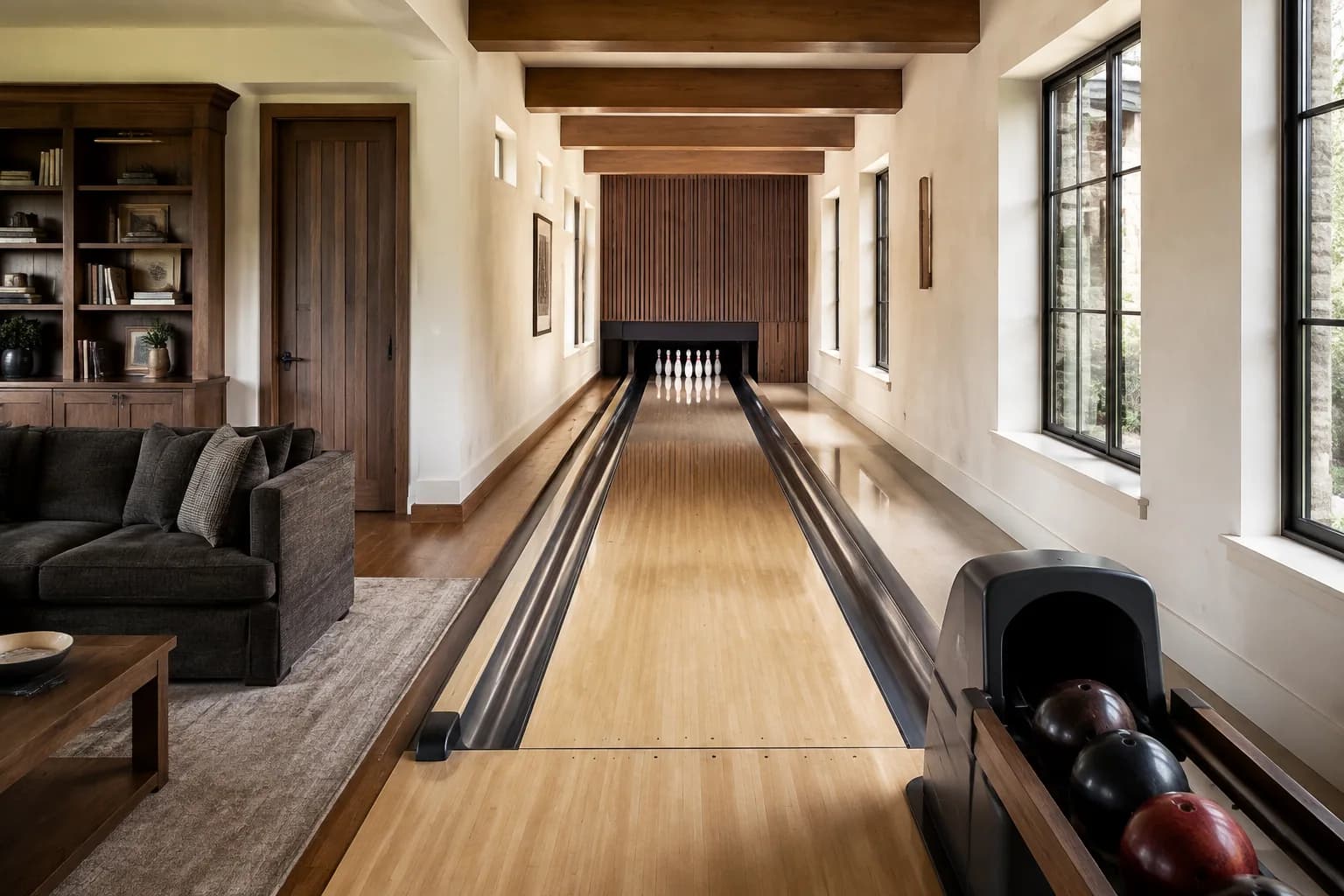
Begin here when familiar full-scale play is central. Test the entire room and equipment envelope rather than assuming the lane surface alone defines the project.
A smaller-format concept may change play, equipment, maintenance, and room planning. Ask exactly what the term means in each proposal.
Treat duckpin as its own operating and equipment brief. Confirm the supported format, service model, and intended household experience.
Compact can describe several different compromises. Identify what changes in play, lane geometry, equipment, access, and long-term support.
Lane count affects more than width. Consider circulation, simultaneous use, equipment arrangement, service access, room character, and the full project scope.
Compare the practical implications of the offered pinsetting system, including operation, service access, parts, warranty, and who will maintain it.
Start by testing whether the intended play, room width, circulation, seating, equipment access, and service route support a single-lane system. A one-lane proposal should still state every shared or standalone component and the work around it.
Test the additional width, circulation, equipment arrangement, access, and room character alongside the benefit of simultaneous or alternating play. Ask which components are shared, which are duplicated, and how that changes installation and future service.
A current Fusion Bowling design guide describes one-, two-, and four-lane considerations, including paired components. That is provider-specific planning guidance, not a universal room rule or a recommendation for either lane count.
Ask each provider to show the exact system, room assumptions, included components, service access, and owner or trade scope for the selected count. Then compare those proposals on the same scope basis rather than assuming that two lanes simply double one lane.
Ask each provider to identify the exact system, included scope, design assumptions, site responsibilities, commissioning process, warranty path, and ongoing service model.
Compare complete-system scope