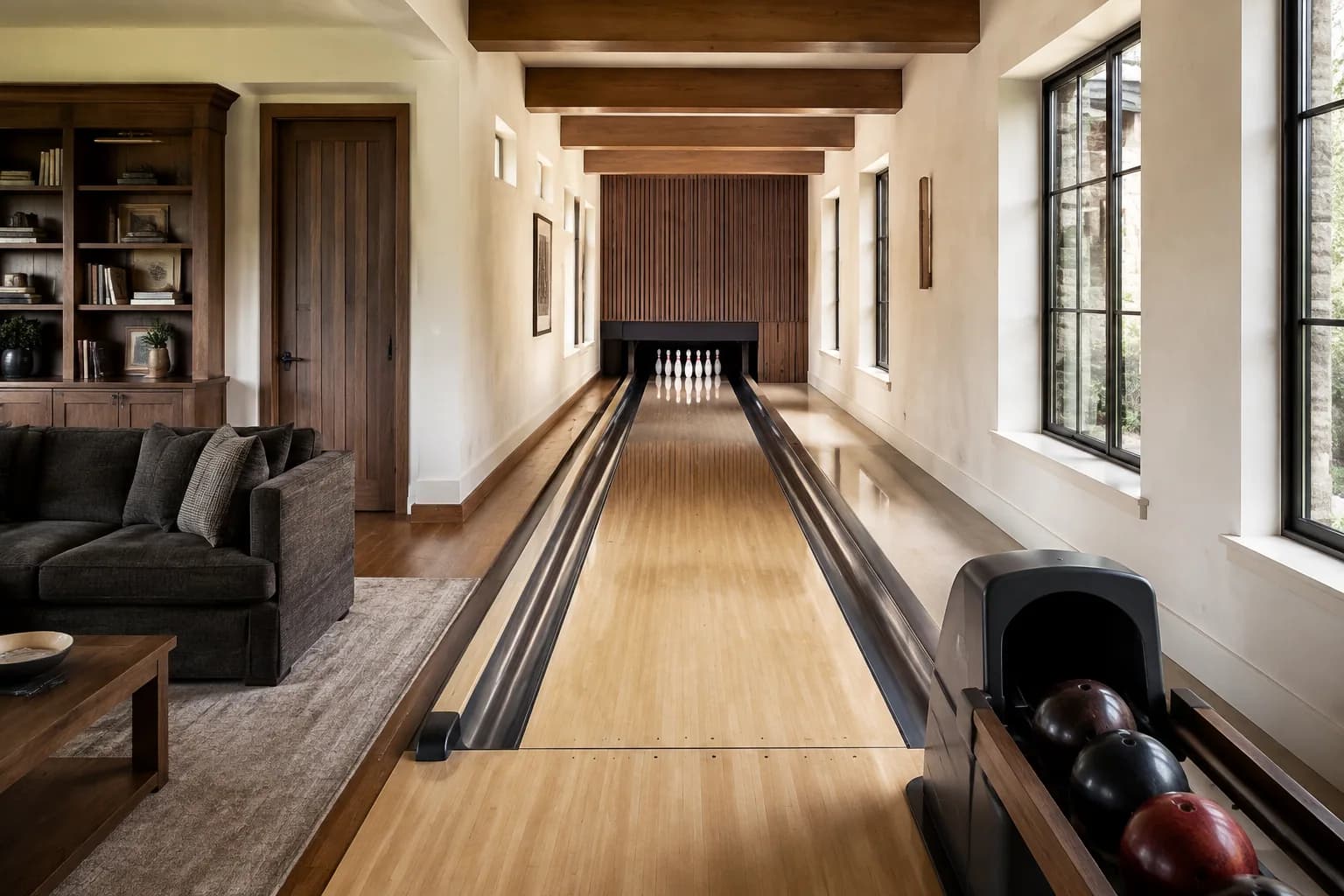
The rendering looks wonderful. Will you enjoy using it?
A private bowling room is an exciting purchase, but photographs cannot tell you how it feels to start a game or spend an evening beside the lanes. You may love the idea and still be unsure whether the equipment will suit the people who use your home.
Ask for a working demonstration before the final equipment decision. Give the provider a short brief about who will bowl and what you want to try. The goal is to come away knowing which features matter to you and which questions still need a written answer for your own project.
Find out how closely the demo matches your quote
Ask the provider to identify the lane format, pinsetter, scoring system, controls and optional features you will see. Compare that list with the proposed equipment. A commercial venue, showroom or completed residential project may be useful, but none should be assumed to match the package you are buying.
If a comparable visit is available, let the provider arrange permission and explain the conditions. Do not expect access to another client's home or service areas. When a visit is impractical, ask for a live guided demonstration of the specific controls and play functions, while recognizing that video leaves the physical experience unresolved.
Keep a short difference list. If the demonstration has an upgraded scoring package or a different lane format, ask which parts of your experience would change. You want to avoid falling for an option that never appears in the final proposal.
Start a game without handing every task to the salesperson
After the operator explains the controls, try entering player names, starting the ordinary game you expect to play and making a permitted score correction. Ask how to finish that game and begin another. Stay within the operator's instructions; this is an owner-use demonstration, not a maintenance exercise.
QubicaAMF's console documentation, for example, describes name entry, score management and access to different games. The available functions depend on the selected system and configuration. Ask to see the functions in your quote instead of assuming that every feature shown in a manufacturer's brochure is included.
Bring the person who is most likely to organize games at home. If you expect guests to use the room, ask how much help a first-time user normally needs and what owner training is provided. A system can offer many features while your household values a straightforward path to an ordinary game most.
Spend some time waiting for your turn
Play enough of a game to experience the pauses as well as the throws. Then sit where a guest would sit. Can you follow the play and see the displays comfortably? Is the person who is not bowling still part of the evening? Notice where bags, shoes and unused balls go.
Fusion Bowling's planning guide treats seating, sightlines and storage as separate room considerations. Those are useful things to observe during a visit. Take your observations back to the designer rather than copying the demonstration room's layout into a space with different doors and circulation.
If you are weighing one lane against two, think about your usual gathering. A demonstration with several active lanes may feel different from a single lane in a quiet home. Ask the provider to help you separate the effect of the equipment from the number of people and the setting.
Turn preferences into specific questions
Try any quoted assistance or entertainment options that matter to your household under the operator's guidance. Ask how they are selected and whether they can be changed between players or games in the proposed configuration. Do not buy an option solely because the presenter makes it look effortless.
Ask the supplier what the demonstrated software needs to keep working at your address, including any connectivity, account, update or support requirements. Have recurring charges and included licenses stated in the proposal where applicable. The demonstration itself cannot settle future availability or commercial terms.
Listen to the system, but resist turning what you hear into a promise for your own home. Room construction, adjacent spaces and the selected equipment all matter. If sound is a deciding concern, give your design team the concern and request project-specific assessment; a phone recording or showroom impression is not that assessment.
Use the visit to make a better decision
Write down three things you liked, anything you found awkward and the differences still unresolved between the demo and your quote. Ask the provider to respond before you approve the equipment. That gives the visit a practical result beyond another set of attractive photographs.
Our vetted experts can help you prepare a useful demonstration brief through their experience and relationships with providers. Tell us who will use the lanes, what kind of play you enjoy and which decisions you are finding hardest. We can help you turn that into questions worth answering before the purchase.