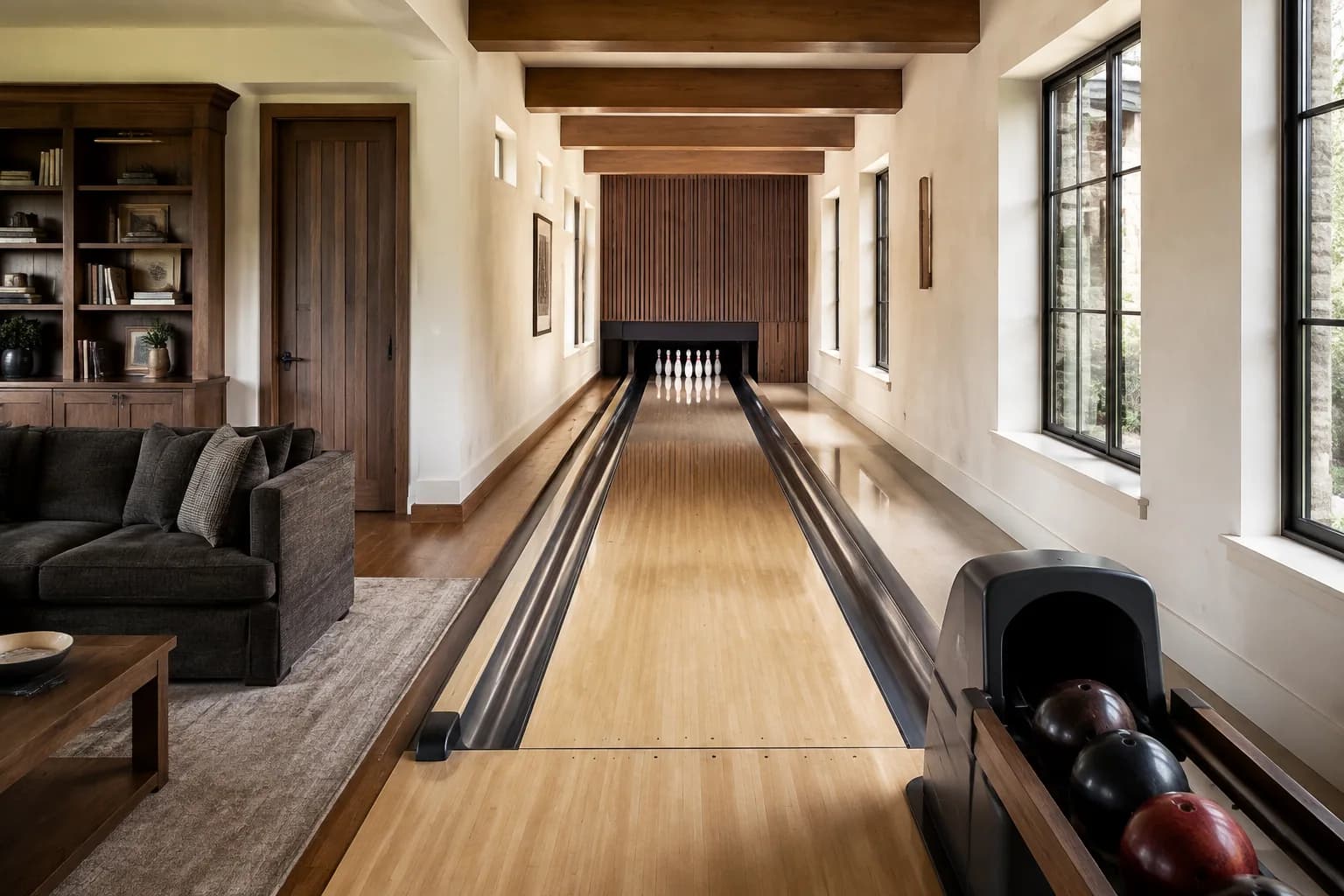
Picture the evening before you choose the lane count
You’ve found space for bowling at home, and now the drawing has a tempting second lane. Will it make the room more fun, or become an expensive strip of floor that rarely gets used? Start with the people who will actually bowl, rather than the biggest gathering you might host once.
For someone who mainly wants to practice alone, one lane can be a satisfying choice. For a household that regularly gathers friends around a game, ask the installer to draw two. Our judgment is to choose the smallest layout that supports the evening you want without making everyone else perch in a corridor.
What changes when friends come over?
On one lane, everyone in the game shares the same playing area and waits through the same sequence of turns. That can be exactly right when bowling is a relaxed part of a wider evening. If you want two groups playing alongside each other, a second lane gives you another game area rather than simply another place to stand.
Fusion Bowling’s design guide recommends considering pairs: it says its systems share components across two lanes, and describes alternating between lanes as an option for league-style play. Those are useful reasons to ask about two lanes, not proof that every family needs them or every system has the same economics.
Imagine six friends visiting. If half would rather sit and talk, one lane with generous seating may feel better than two lanes in a cramped room. If everyone wants to bowl for most of the evening, compare a pair with seating behind the approaches. These are planning scenarios, not promises about game duration or guest capacity.
Does the second lane fit the whole room?
Ask for one-lane and two-lane plans within the same finished room outline. Include the approach, equipment area, service route, seating, ball and shoe storage, door swings and the way people pass through the space. A second lane that fits only after removing those functions is a different project from the one you imagined.
Fusion’s guide publishes different planning widths for lane counts and treats side access separately. Use the selected installer’s current drawings for the actual system; don’t turn a generic width into permission to build. Our dimensions guide explains why the lane surface alone is an incomplete room measurement.
Look beyond the floor plan. Ask where spectators can see the pins, where someone puts a drink and how guests reach their seats without wandering onto the playing area. Before approving the second lane, make sure the room still works for the person who isn’t bowling.
Ask what the extra lane actually adds to the quote
Request two proposals with the same equipment grade, finishes, scoring package and installation assumptions. Then ask the supplier to explain the difference: which equipment is shared, what is added and what building work changes. A low per-lane figure can distract you from a higher total project cost.
Keep the construction comparison beside the equipment comparison. More width may affect the room you build, finishes, electrical coordination and acoustic design. Those costs won’t necessarily appear in the bowling installer’s number. Have your project team identify the changes rather than applying an assumed percentage.
Ask whether the price includes everything needed to operate either layout, including delivery, installation, commissioning and training. If an accessory is shared between lanes, confirm that in the actual proposal. Manufacturer or installer statements about pairing should never substitute for the scope you’re buying.
Could you add the second one later?
Treat future expansion as a design option that needs a drawing and a price. Ask the installer what must be reserved now, which equipment choices remain compatible and what would have to be removed or rebuilt. Leaving an empty strip beside a lane doesn’t establish that expansion will be straightforward.
If the future plan is vague, decide whether you would still be happy with one lane permanently. That is a stronger basis for buying than relying on an unpriced upgrade. If two lanes are clearly your long-term goal and the room supports them, compare completing both now against the actual disruption of returning later.
Also ask how routine care changes with the lane count. Two lanes add surfaces and equipment to look after, even where some components are shared. Have the provider explain the owner tasks and support arrangement for each option; don’t assume either double the maintenance bill or no meaningful difference.
Make the decision around your household
Choose one when it delivers the practice or casual game you want and leaves the room comfortable. Choose two when regular group play justifies the additional footprint and complete installed cost. If the choice is close, a visit to a comparable installation can make the seating and waiting experience easier to judge than another rendering.
Tell our vetted experts how many people usually join you, how often you expect to bowl and what space you’re considering. Their field experience and provider relationships can help you compare the two layouts and ask for a proposal that reflects how your family will use the room.